Research presentations, scientific sessions, educational programs, and poster discussions highlight the trainee’s experience at the event.
By Dr. Sidharth Suresh
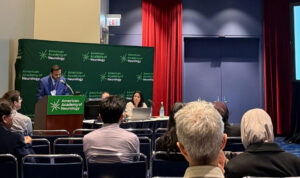
Dr. Sidharth Suresh presents research into how agreement between video EEG and MRI findings influences seizure outcomes after surgery in children and adults with focal drug-resistant epilepsy at the 2026 American Academy of Neurology Annual Meeting.
With the support of the World Federation of Neurology’s (WFN) 2026 Traveling Fellowship Award, I presented my research at the 2026 American Academy of Neurology (AAN) Annual Meeting in Chicago.
My study, conducted at the All-India Institute of Medical Sciences (AIIMS) in New Delhi, evaluated how agreement between video EEG and MRI findings influences seizure outcomes after surgery in children and adults with focal drug-resistant epilepsy. Drawing on one of the largest surgical epilepsy cohorts from South Asia, it showed that EEG-MRI concordance strongly predicts postsurgical seizure freedom.
Importantly, patients with discordant findings still achieved good overall seizure control, suggesting that carefully selected discordant cases should not be excluded from surgical consideration, a finding of relevance to resource-limited settings.
The fellowship made it possible for me to bring epilepsy surgery data from an Indian tertiary center to one of the world’s largest neurology meetings. Presenting at AAN 2026 brought a large South Asian surgical cohort before an international audience, where such data are still underrepresented.
I discussed the findings with epileptologists, neurophysiologists, and epilepsy surgeons. Their questions on patient selection, invasive monitoring in discordant cases, and outcome definitions helped shape the next stage of the analysis and the manuscript.
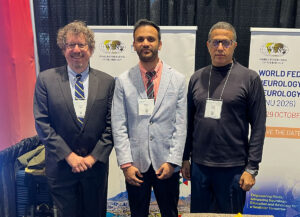
From left to right: Prof. Steven Lewis, WFN president, Dr. Sidharth Suresh, and Prof. Riadh Gouider, WFN first vice president.
Scientific sessions, education programs, and poster discussions exposed me to current advances in presurgical evaluation, neuroimaging, and neuroimmunology. I exchanged ideas with researchers from many countries, including peers working in resource-limited settings.
Meeting the WFN team at the conference let me learn more about WFN’s educational and outreach initiatives and how early career neurologists from low- and middle-income countries can contribute. Connections made at the meeting opened possibilities for multicenter collaboration and for validating these findings in other cohorts.
I sincerely thank the WFN for the Traveling Fellowship Award. I am also grateful to my mentors and colleagues at AIIMS in New Delhi, where this work was carried out, and to the patients and families who took part. I look forward to continuing my association with the WFN and contributing to this amazing field of neurology and neuroscience. •
Dr. Sidharth Suresh, MBBS, MD (internal medicine), DM (neurology), is a postdoctoral fellow in autoimmune neurology in the Department of Neurosciences at the Mayo Clinic in Jacksonville, Florida. His research was performed at AIIMS in New Delhi during his DM neurology residency.