The WFN Specialty Group on Aphasia, Dementia, and Cognitive Disorders spotlights behavioral neurology, psychiatric disorders, and brain health equity.
By Dr. Aida Suárez-González, Prof. Morris Freedman, Prof. Manabu Ikeda, Dr. Jordi Matías-Guiu, Dr. Lara Migliaccio, and Prof. Peter Nestor
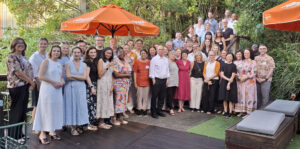
Attendees of the WFN ADCD Specialty Group biennial meeting at Peppers Noosa Resort and Villas at Noosa Heads, Australia.
Noosa Heads, Australia, is known for its long, rolling waves, distinctive surfing culture, and pristine coastal landscape. It provided a spectacular setting for the 2026 biennial meeting of the World Federation of Neurology (WFN) Specialty Group on Aphasia, Dementia, and Cognitive Disorders (ADCD). This was the first time the meeting had traveled to Australia, following an initiative championed and organized by Prof. Peter Nestor with the support of the Australasian Cognitive Neurology Association. Against the backdrop of the Pacific coastline, more than 100 delegates from five continents gathered at Peppers Noosa Resort & Villas for four days of science and community.
The conference opened with a plenary lecture by Prof. Morris Freedman, marking the 60th anniversary of the Specialty Group. The occasion also provided an opportunity to celebrate his recent appointment to the Order of Ontario, the province’s highest civilian honor, in recognition of his outstanding contributions to behavioral neurology and cognitive disorders.
The program covered the full landscape of behavioral neurology, from prevention and diagnosis to pathology and care. Chi Udeh-Momoh’s Precision Prevention Symposium looked ahead through Africa-FINGERS, culturally adapted programs, and the emerging concept of compression of disability.
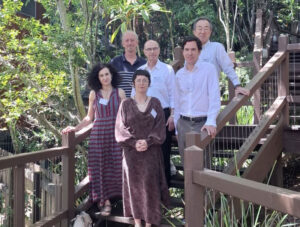
The executive committee of the WFN Specialty Group on Aphasia, Dementia, and Cognitive Disorders. From front to back, left to right: Dr. Aida Suárez-González (ADCD chair), Dr. Lara Migliaccio, Prof. Peter Nestor (host), Prof. Morris Freedman, Dr. Jordi Matias-Guiú, and Prof. Manabu Ikeda.
At the more difficult diagnostic borders, Prof. Nestor addressed behavioral variant frontotemporal degeneration, phenocopies, and primary psychiatric disorders, while Prof. Glenda Halliday and Sydney’s world-leading neuropathology group led delegates beyond Alzheimer’s disease into primary age-related tauopathy, limbic-predominant age-related TDP-43 encephalopathy, chronic traumatic encephalopathy and age-related tau astrogliopathy, and cerebrovascular disease.
Language, behavior, and everyday life formed another strong thread. Symposia chaired by Profs. Olivier Piguet and Muireann Irish explored primary progressive aphasia and neuropsychiatric disturbances in younger-onset dementia. Dr. Naomi Folder and Dr. Cathleen Taylor-Rubin brought communication partner training and speech pathology interventions into the clinical conversation.
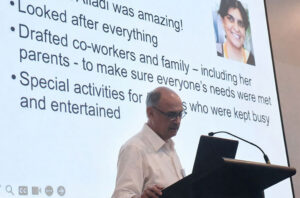
Prof. Morris Freedman delivered the plenary session at the 60th anniversary meeting of the WFN’s Aphasia, Dementia, and Cognitive Disorders Specialty Group, tracing the group’s history from its beginnings 60 years ago. Prof. Freedman commemorated the legacy of Prof. Suvarna Alladi, former chair.
The program widened to include brain health equity in aboriginal populations, rare dementia support, and long COVID through symposia chaired by Prof. Adrienne Withall, Prof. Sebastian Crutch, and Dr. Jordi Matias-Guiu. Free-paper sessions kept the horizons broad, adding neuroimaging, linguistics, new assessment tools, and caregiver support.
Noosa itself became part of the meeting, with a free morning to spend together on the beach and walks through Noosa National Park. These were moments that allowed conversations and new connections to grow beyond the conference rooms, reflecting the care and hospitality that Prof. Nestor brought to the meeting.
In autumn 2026, representation from the Specialty Group will travel to Bengaluru, India, to support the second meeting of the Cognitive Neurology Association of India. In 2028, ADCD will cross oceans once again, this time May 11-14 in Cádiz, Spain. Save the date! We look forward to welcoming you all to Spain for the next chapter of the ADCD story. •
Dr. Aida Suárez-González is an Alzheimer’s Society Dementia Research leader fellow, consultant clinical neuropsychologist at UCL Queen Square Institute of Neurology at University College London, U.K., and chair of the WFN ADCD Specialty Group. Prof. Morris Freedman is WFN treasurer, professor in the department of medicine (neurology) at the University of Toronto, head of the division of neurology, medical director of the Pamela and Paul Austin Centre for Neurology and Behavioral Support, and a scientist at the Rotman Research Institute at Baycrest Health Sciences in Toronto, Canada. Prof. Manabu Ikeda is professor of psychiatry and chair of the department of psychiatry at Osaka University in Osaka, Japan. Dr. Jordi Matías-Guiu is a clinical neurologist and researcher in the department of neurology at Hospital Clínico San Carlos in Madrid, Spain, and faculty member of the Center for Cognitive Neuroscience and Aging at the University of Miami, Florida. Dr. Lara Migliaccio is a neurologist and INSERM researcher at the Paris Brain Institute (ICM) and principal investigator at the FrontLab team, Pitié-Salpêtrière Hospital in Paris, France. Prof. Peter Nestor is conjoint professor of cognitive neurology at the Queensland Brain Institute at the University of Queensland and Mater Hospital in Brisbane, Australia, and local organizing chair of the 2026 WFN ADCD biennial meeting.