Exploring the relationship between Jean Béraud’s “La Madeleine Chez le Pharisien” and André Brouillet’s “Une Leçon Clinique à la Salpêtrière.”
By Peter J. Koehler
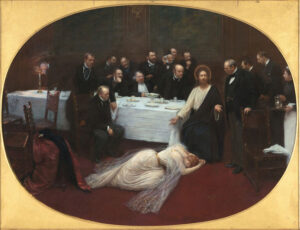
Figure 1. Jean Béraud, “La Madeleine Chez le Pharisien,” (1891), oil on canvas, 101.2 x 131.5 cm, Gift of Mr. and Mrs. Robert Walker, 1982, © RMN-Grand Palais (Musée d’Orsay, inv. no. RF 1982 55) / Hervé Lewandowski). (The use of these reproductions is strictly for noncommercial purposes.)
The French painter Jean Béraud (1849-1935) created the painting “La Madeleine Chez le Pharisien (Magdalene in the House of the Pharisee).” (See Figure 1.) The painting caused a stir when it was exhibited in 1891 at the second Salon of the Société Nationale des Beaux-Arts in Paris. There is a striking resemblance to a famous painting, well-known among neurologists, created four years earlier by his younger colleague André Brouillet (1857-1914): “Une Leçon Clinique à la Salpêtrière (A Clinical Lesson at the Salpêtrière).” (See Figure 2.)
In this article, we will compare the two paintings and see whether Béraud may have been inspired by Brouillet’s painting of Charcot’s (1825-1893) lecture.
Jean Béraud
Béraud was born in St. Petersburg, the son of the sculptor Jean Béraud (1811-1853), who likely contributed to the construction of St. Isaac’s Cathedral (1819-1858), and Geneviève Eugénie Jacquin (1814-1886). After his father died, his mother returned to Paris with her four children. Jean Jr. studied law and then worked as a lawyer until the Franco-Prussian War (1870-1871).
In 1871, he enrolled in painting classes at the studio of Léon Bonnat (1833-1922) at the École des beaux-arts of Paris.1 He made his debut at the 1872 Salon and became a painter interested in everyday life on the boulevards of Paris as well as of evenings and Salons, where people gathered to discuss ideas and network among the upper classes. He painted in various styles; between 1875 and 1900, he created some 30 beautiful paintings in the Impressionist style.2
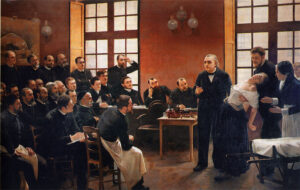
Figure 2. André Brouillet, “Une Leçon Clinique à la Salpêtrière” (1887) © Musée d’Histoire de la Médecine, Paris (public domain).
Béraud became friends with Marcel Proust (1871-1922), another regular at the Salons who began his social life around 1890. Proust wrote “A la Recherche du Temps Perdu (In Search of Lost Time)”; (1913-1927). He wrote about Béraud as a “young and celebrated master,” “an artist acclaimed by the old world and the new,” “a charming creature sought, in vain, by every social circle,” and “the wittiest of men.”2
Proust asked him to be his second in the famous pistol duel on Feb. 6, 1897, against the journalist and writer Jean Lorrain (pseudonym of Paul Duval; 1855-1906), who was a friend of Liane de Pougy (1869-1950). The character of the painter Elstir of “In Search of Lost Time” was composed of a mixture of painters Jacques-Emile Blanche (1861-1942), Paul César Helleu (1859-1927), Henri Gervex (1852-1929), Edouard Vuillard (1868-1940), James M. Whistler (1834-1903), and Jean Béraud.2
André Brouillet
Brouillet, who was eight years younger than Béraud, was also the son of a sculptor, Pierre-Amédée Brouillet (1826-1901), and of Marie Élisabeth Lériget (1826-1897). He was born in western France (Charroux, Vienne) and studied engineering in Paris before deciding to become a painter (1879) and attended the École Nationale Supérieure des Beaux-Arts. He was a student of Jean-Léon Gérôme (1824-1904) and of Jean-Paul Laurens (1838-1921). In 1879, he was admitted to the Salon — seven years after Béraud.
Brouillet painted portraits, historical scenes, scenes from everyday life in Paris, and Oriental scenes. When Impressionism came into vogue, he continued to adhere to his academic style. This conservatism earned him numerous commissions, including portraits of the venereologist Félix Balzer (1849-1929) and neurologist Joseph Babinski (1857-1932; the portrait was lost). Likewise, the 1887 “Portrait de Mdm. C…,” exhibited at the Salon in the same year as “Leçon,” is probably a portrait of Charcot’s wife Augustine-Victoire Charcot-Laurent (1834-1899),3,4 who was a well-known figure in Paris art world.5
Béraud’s “La Madeleine Chez le Pharisien”
The similarity in the composition is striking. Jesus (on “La Madeleine”) and Charcot (on “Leçon”) are on the right side of the paintings. The servant (on “La Madeleine”) and the nurse (on “Leçon”) are both wearing white aprons and are standing on the far right. Mary Magdalene (on “Leçon”) is wearing a white evening gown; her shoulders are covered by a sheer veil adorned with embroidery. She threw her cape over a chair — a cape with a diamond clasp. Patient Marie (Blanche) Wittman (1859-1913; on “Leçon”) is wearing a black dress and a white blouse and is fainting into the arms of Joseph Babinski. The people surrounding the main characters, only men in both paintings, were well-known French citizens.
“La Madeleine” depicts a timeless Christ, dressed in a white shirt and a long black coat, seated at the head of the table in a late 19th-century Parisian living room. The historical meal at Simon’s house — the wealthy Pharisee — echoes an artistic tradition. The subject is well known and has been depicted countless times.6
Mary Magdalene is perhaps one of the best-known, but certainly also one of the most notorious women in the New Testament. We don’t know much about Mary Magdalene. Her name tells us that she was from Magdala. She traveled with Jesus throughout Galilee and was also present during Jesus’ Passion, his crucifixion, and probably his burial as well.
The Pharisees were often regarded as opponents of the early Christians, but according to experts, this is a narrow view that does not do justice to their broader historical significance and the important role they played in shaping Jewish religious life during the Second Temple period and beyond. The leadership of the Pharisees should also be evaluated by examining their positive contributions to both Judaism and the fundamental development of early Christianity.7
Well-Known Contemporaries in Both Paintings
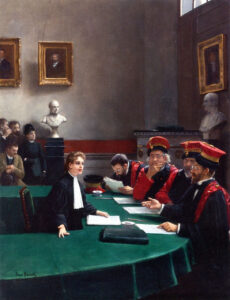
Figure 3. Jean Béraud, “Salle D’examen de Doctorat” or “Le Jury du Doctorat (The Doctoral Jury)” (1875), oil on canvas, 63.5 x 48.3 cm, sold at Christie’s in October 1975 under the title “L’Étudiante en Médecine (The Medical Student)”; private collection) (public domain). According to the information in the dissertation,17 thesis examiners were Dean Charles Adolphe Wurtz (1817-1884), chair; anatomist Marie Philibert Constant Sappey (1810-1896), chemist Armand Gautier (1837-1920), surgeon Odilon Marc Lannelongue (1840-1911), and Alexandre Pinet (b. 1822), secretary. In the painting, however, it is not easy to recognize them.
On Brouillet’s “Leçon,” 8,9 all men depicted in the painting can be recognized as well-known contemporary persons. Physician and medical historian Olivier Walusinski has devoted an entire book to the famous painting.4 “Leçon” features more than just doctors. It also includes Pierre Marie (1853-1940), Edouard Brissaud (1852-1909), Paul Richer (1849-1933) — who was also an artist — Gilbert Ballet (1853-1917), Georges Gilles de la Tourette (1857-1904), Désiré-Magloire Bourneville (1840-1909), and Henri Parinaud (1844-1905).
Nonmedical contemporaries can also be found, including Victor Cornil (1837-1908), politician; Philippe Burty (1830-1890), art collector and writer; Jules Claretie (1840-1913), journalist and writer; and Paul Arène (1843-1896) novelist.
The same applies to “La Madeleine,” although the well-known contemporaries on this painting are not doctors. The depiction of contemporary figures in this painting caused a scandal. People recognized in Mary Magdalene the likeness of the famous dancer and courtesan, Liane de Pougy, whose real name was Anne-Marie Chassaigne (1869-1950). She later became a writer and member of the Third Order of Saint Dominic as Sister Anne-Mary.
In front of the table on the left, we see the Jean Béraud himself, behind the physician turned journalist and statesman Georges Clemenceau (1841-1929). After obtaining his MD in 1865, Clemenceau spent some time in the United States and returned in 1869.10 At that time, he was a representative of the Radical Party and advocated for a program of compulsory, secular elementary education, and thus for a reduction in the influence of the church and a separation of church and state.5
On the right side of the painting, next to Jesus, we recognize author and playwright Alexandre Dumas Fils (1824-1895), best known for the 1848 romantic novel “La Dame aux Camélias (The Lady of the Camellias).” That novel inspired Giuseppe Verdi (1813-1901) for the famous opera “La Traviata” (1853; also known as “The Fallen Woman,” in which the courtesan Violetta is the main character).
In Jesus, one could recognize the portrait of the socialist journalist Albert Duc-Quercy (1856-1934). Behind the table, one could make out an elderly man cupping his hand around his ear. This was the elderly chemist Michel Chevreul (1786-1889), who had played a role in the history of lipids and cholesterol,11 and had passed away two years prior at the age of 103. He had been director of the Gobelins Manufactory in Paris and published on color theory. His concepts had been important to the emergence of the Impressionist movement.
In the middle of the group, the man with his napkin still around his neck is philosopher, historian, and scholar of religion Ernest Renan (1823-1892), who was central to the religious debate of his time and is represented as the host of the dinner, Simon the Pharisee. His book “Vie de Jésus (The Life of Jesus),” published in 1863, was strongly condemned by the church. He struggled to reconcile his historical critique of the sources of Christianity with his shaken personal piety. He described Mary Magdalene as delusional and suggested that she made up the resurrection in a moment of being blinded by love. The book provided fodder for controversy, and there were many such controversies starting in 1863.
Renan is portrayed alongside the enemies of the church, the advocates of secularism (including Clemenceau) and the sententious, self-righteous moralizers, such as Dumas. According to art historian Gilbert Croué, Renan, who had just published “The Future of Science” in 1890, which was a positivist manifesto rejecting the supernatural, this painting is a witness of the incredible repentance of Mary Magdalene (portrayed as Liane).5
No Overlap of Individuals
Looking at possible connections between Charcot and persons depicted in “La Madeleine,” we have to realize that with regard to politics and religion, Charcot apparently did not openly involve himself in political issues. However, he surrounded himself with colleagues who held strongly anticlerical views.12 Charcot was a friend of the republican politician Léon Gambetta (1838-1882), who played a role in establishing Charcot’s chair for diseases of the nervous system in 1881.11
Clemenceau, who, unlike Gambetta, is depicted in “La Madeleine,” may have been an acquaintance of Charcot’s, as both of them were regulars at the Thursday evening Salon hosted by Charcot’s rear neighbor, the writer Alphonse Daudet (1840-1897), who was also his patient for some time.11
Several other famous figures were depicted in Béraud’s “La Madeleine,” some of whom were also acquaintances of Charcot. This included historian and philosopher Hippolyte Taine (1828-1893), who at least once attended a “‘private session’ (of Charcot)… in which the ‘celebrated Wittman’ would be ‘exhibited.’”11
Other celebrities in “La Madeleine” are journalist Jean-Jacques Weiss (1827-1891), journalist and politician John Lemoinne (1815-1892), historian and art collector Edmond Taigny (1828-1906), and Marcel Proust’s father Dr Adrien Proust (1834-1903; see “The Framing of Neurasthenia,” World Neurology, Aug. 2026). However, there is no overlap regarding the individuals depicted between “La Madeleine” and “Leçon.”
Not all reviewers were critical of “La Madeleine.” Journalist, playwright, and art critic Albert A. Wolff (1825-1891) noted:
Béraud “brings Jesus into the house of a modern Pharisee, who is wearing a frock coat, like all his guests. In front of this audience of contemporary sceptics, Christ pardons the woman’s sins. The old masters thought nothing of mixing their own age with the legends they depicted. This attempt at transporting the Gospel into our bourgeois society may surprise some: but there is no reason in theory why this legend should not be reinterpreted in terms of our own civilization. Whether dressed in sumptuous robes or in a frock coat, the man beneath remains in some ways the same, doubting those things he does not understand, and mocking that which lies beyond his own everyday concerns. Perhaps that is what M. Jean Béraud wanted to demonstrate in this unusual work, which has drawn so much attention, and in which he has gone much further in his study of character than in anything he had previously shown.”2
In his “Le Salon de 1891,” journalist and politician Antonin Proust (1832-1905; no relation to Marcel Proust) commented: “M. Jean Béraud est de son côté très en progrès. Jamais il n’a poussé plus loin le fini de l’observation. La foule s’est écrasée autour de la Madeleine chei le Pharisien, qui a des qualités de premier ordre. (For his part, Mr. Jean Béraud has made great strides. Never before has he taken the art of observation to such heights. The crowd surged around the Madeleine near the Pharisien, which possesses first-rate qualities.)”13
Béraud, Madeleine Brès, and Women’s Emancipation
Jean Béraud was likely familiar with academic circles, not only because he had studied law, but also, as evidenced by his painting “Salle D’examen de Doctorat” or “Le Jury du Doctorat.”2 The painting depicts Madeleine Brès (1839-1925; see Figure 3), the first French woman allowed to pursue medical studies at the Faculté de Médecine in Paris. However, before Madeleine Brès, three foreign women had already been admitted to the medical school: Mary Putnam (1842-1906; American, born in London), Catherine Gontcharoff (Russian), and Elizabeth Garrett (1836-1917; English).
Although the woman depicted in the painting has also been mentioned to be Elisabeth Garrett, later studies confirmed that it was Madeleine Brès.14 This is confirmed by a comparison of portraits with the person in “Le Jury.” Brès, who had already asked dean Charles Adolphe Wurtz (1817-1884) in 1866 for permission to study medicine, finally defended her doctoral thesis “De la Mamelle et de L’allaitement: Thèse pou(r) le Doctorat en Médecine Présentée et Soutenue le Jeudi 3 Juin 1875 (On the Breast and Breastfeeding: A Dissertation for the Doctorate in Medicine, Presented and Defended on Thursday, June 3, 1875)” and graduated summa cum laude.
The painting is undated, but it was likely created shortly after her defense in 1875. Among others, Brès dedicated her dissertation to surgeon Paul Broca (1824-1880), under whom she had worked as a student. Broca played an important role in the concept of cerebral localization.
He later wrote: “Mrs. Brès was designated as a temporary intern. In this capacity, during the two sieges of Paris and until the month of July 1871, she performed her duty with an exactitude that was not even hindered by the bombing of the hospital. Her work has always proved very satisfactory and her behavior faultless.”15,16 It is likely that Madeleine Brès was also acquainted with Charcot, as he is mentioned in her dissertation as one of the professors of the Faculté de Médecine de Paris (pathological anatomy).17
Béraud’s interest in the subject also relates to a pen, watercolor, and gouache fan with the title “Les Femmes Savantes (Women Scholars).” The recognized expert on Béraud, Patrick Offenstadt wrote: “Béraud describes the preparation of this fan in letter L 52. On the fan, he humorously details the advances in women’s rights. He represents women performing activities normally performed only by men at this time. In the foreground, the painter (the young woman is followed by her maidservant carrying a life study), the doctor, and the magistrate. In the background: a cyclist, a woman with her hands in her pockets, and a woman dressed as a coachman. The setting is the Institut de France and the Chambre des Députés.”2
Béraud and His “Les Fous”
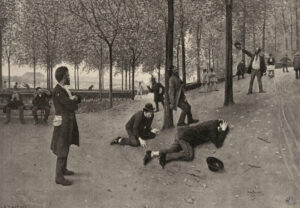
Figure 4. Jean Béraud, “Les Fous (The Madmen);” original painting lost (oil on canvas, 112 x 142 cm).2 Engraving by Henri Linton (c. 1885). (public domain).
In his book, Offenstadt, depicted both paintings Béraud’s “La Madeleine” and Brouillet’s “Leçon.”2 He introduced Brouillet’s painting by explaining how madness became a popular subject in Paris in the 1880s and how Jean Béraud, who was apparently interested in this subject, painted his “Les Fous (The Madmen),”2 a painting that occupied a prominent place at the 1885 Salon, but was eventually lost. A reproduction of the painting survived as an engraving, made by the British engraver Henri Linton, (1815-1899) around 1885. (See Figure 4.)
On “Les Fous,” Offenstadt wrote: “Till now, Béraud had owed his success largely to his scenes of high society and everyday life, and this daring new departure took everyone by surprise.”2 It shows a scene on the grounds of Saint Anne’s Asylum in Paris.
At the time, art historian Paul Mantz (1821-1895) wrote: “Il a visité un asile d’aliénés. Sur un terrain planté d’arbres en quiconce, il a représenté une collection de fous réunis en plein air sous la surveillance des gardiens de la maison. Ces fous, il les a triés sur le volet, car tout n’est pas bon à peindre et à souligner dans cet ordre d’études médicales. (He visited a mental asylum. On a plot of land planted with trees in a quincunx pattern, he depicted a group of lunatics gathered outdoors under the watchful eye of the asylum’s guards. He handpicked these lunatics, for not everything is worth painting or highlighting in this line of medical research.)”18,19
Offenstadt believed that the journal Iconographie Photographique de la Salpêtrière, “whose three volumes documented all the symptoms of his patients’ suffering, even the most spectacular ones,” had been an important resource for the general public.2 Apparently, the author was not aware of the fact that Charcot was a neurologist, professor of diseases of the nervous system, and not a psychiatrist.
However, at the time most nonacademic practicing physicians in these fields were “nerve-doctors” (neuropsychiatrists), who treated both types of patients, neurologic as well as psychiatric. At the time, Charcot considered “hysteria” an organic, later a dynamic or functional disease (although not in the modern sense; see “The Framing of Diseases Throughout History,” World Neurology, May-June 2026).20
“Leçon” and “La Madeleine” at the 1887 and 1891 Art Salons
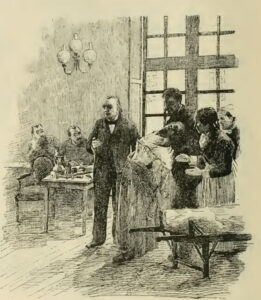
Figure 5. Fragment of “Leçon Clinique à la Salpêtrière” as depicted in Salon de 1887. Catalogue Illustré.22 (public domain).
The Salon, also known as the Paris Salon, which began in 1667, was the official art exhibition of the Académie des Beaux-Arts. Between 1748 and 1890, it was undoubtedly the largest annual or biennial art event in Europe. Brouillet’s “Leçon” was exhibited at the 1887 Salon and Béraud’s “La Madeleine” four years later in 1891.
Art critic Gustave Ollendorf (1850-1891) wrote about “Leçon”: “La lumière comprend son rôle et son devoir. Elle ne confond pas la fantaisie avec la science. … N’est-ce pas une belle chose que cette égale répartition du jour sur un auditoire attentif assistant, dans une des grandes salles de la Salpêtrière, à une leçon du docteur Charcot? Tous les personnages sont baignés dans la même lumière, dont l’effet a été habilement soutenu par le peintre, et c’est là le mérite essentiel de son œuvre qui en possède quelques autres. (Light understands its role and its duty. It does not confuse fantasy with science. … Isn’t it a beautiful sight — this even distribution of light across an attentive audience gathered in one of the great halls of the Salpêtrière to hear a lecture by Dr. Charcot? All the figures are bathed in the same light, an effect skillfully rendered by the painter, and this is the essential merit of his work, which possesses several others as well.)”
The art critic also described the patient: “La femme, dont la névrose sert de thème à la leçon, est à portée du docteur. Le corsage défait, elle se renverse en arrière dans une crispation nerveuse qui expose sa poitrine nue à la lumière vive. (The woman, whose neurosis is the subject of the lesson, is within the doctor’s reach. With her blouse undone, she leans back in a nervous spasm that exposes her bare chest to the bright light.)”21 At the same 1887 Salon, Jean Béraud exhibited “Au Palais” and “Le Cantique.” It is likely that Béraud had seen Brouillet’s “Leçon.” (See Figure 5.)22
We may conclude that, although Béraud was familiar with academic circles and psychiatry, it remains unclear whether he ever attended Charcot’s lectures, or whether he was familiar with the journal Iconographie Photographique, but he must have been familiar with Brouillet’s painting “Leçon.” On the other hand, it is also possible that the similarity between “La Madeleine” and “Leçon” is based solely on a well-known technique in paintings, namely that of emphasizing a portion of the canvas by highlighting a figure dressed in white or by focusing the incoming light on that area.
References:
- Guber D. Jean Béraud ‘s “St. Mary Magdalene in the House of Simon the Pharisee” Last accessed June 20, 2026.
- Offenstadt P. Jean Béraud 1849-1935. The Belle Époque: A Dream of Times Gone By. Catalogue Raisonné. Taschen Verlag GmbH, 1999.
- Pedro MKF, Souza TFS, Germiniani FMB, Teive HAG, Walusinski O. Beyond ‘A Clinical Lesson at La Salpêtrière’: a brief assessment of André Brouillet’s other paintings on medical subjects, life, and times. Arq Neuropsiquiatr. 2021;79:1145-1148.
- Walusinski O. “Une Leçon Clinique à la Salpêtrière.” André Brouillet (1857-1914). Brou, Oscitatio, 2021, pp. 15-26.
- Koehler PJ. The stone of madness: Charcot’s interest in a copy after Pieter Bruegel Sr. as referred to by Henry Meige. J Hist Neurosci. 2025;34:355-367.
- Croué G. Marie-Madeleine: du voile au dévoilé. In: Marie-Madeleine, figure mythique dans la littérature et les arts. http://www.persee.fr/doc/pubp_1242-7888_1999_ant_24_1_2678 Last accessed July 14, 2026 Clermont-Ferrand: Presses universitaires Blaise-Pascal, 1999. pp. 265-275.
- Bvumbi AE., ‘People-conscious leadership: Strategic and tactical strengths of Pharisees in early Christianity’, Verbum et Ecclesia 2025;46, a3334. https://doi.org/10.4102/ve.v46i1.3334 Last accessed June 20, 2026.
- Signoret JL. “Une Leçon Clinique a la Salpêtrière (1887) par André Brouillet (A Clinical Lesson at the Salpêtrière)” (1887) by André Brouillet]. Rev Neurol (Paris). 1983;139(12):687-701.
- Harris JC. “A Clinical Lesson at the Salpêtrière.” Arch Gen Psychiatry. 2005 May;62(5):470-2.
- Georges Clemenceau | French Prime Minister & WWI Leader | Britannica Last accessed July 14, 2026
- McNamara JR, Warnick GR, Cooper GR. A brief history of lipid and lipoprotein measurements and their contribution to clinical chemistry. Clin Chim Acta. 2006;369:158-67.
- Goetz CG, Bonduelle M, Gelfand T. Charcot. Constructing neurology. New York, Oxford University Press, 1995.
- Proust A. Le Salon de 1891. Paris, Bousson, Valadon & Cie, 1891.
- Beaupère N, Erard C. Les Femmes Dans L’enseignement Supérieur: Une (R)évolution Inachevée. Céreq, 21, 2023, Céreq Echanges, p. 5.
- Pigeard-Micault N. A History of Women’s Entrance Into Medicine. October 2007. Translation by Debbasch K. A History of Women’s Entrance Into Medicine — Medica — BIU Santé, Paris Last accessed July 16, 2026.
- Koehler PJ. Gabrielle Lévy and the Roussy-Lévy syndrome. J Hist Neurosci. 2018;27:117-144.
- Brès M. De la Mamelle et de L’allaitement: Thèse Pou(r) le Doctorat en Médecine Présentée et Soutenue le Jeudi 3 Juin 1875. Dissertation, Paris, 1875.
- The Mad Writer, Study for “Les Fous” | Reflections on Reality Last accessed July 15, 2026.
- Mantz P. Le Salon. Feuilleton du Temps du 14 Juin 1885, p. 1.
- Koehler P. The Framing of Diseases Throughout History Last accessed July 19, 2026.
- OIlendorf G. Salon de 1887. Paris, Ludovic Baschet, 1887.
- Anonymous. Salon de 1887. Catalogue illustré. Ludovic Baschet, 1887