Reporting on a year of career highlights at the WFN Training Center at the Hôpital des Spécialités in Rabat, Morocco.
By Dr. Sangare Cheickna
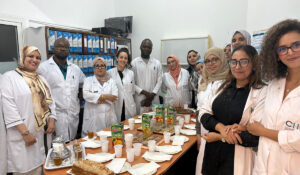
Dr. Sangare Cheickna (center) and members of the staff at Hôpital des Spécialités in Rabat, Morocco.
It is an honor to submit this report marking the completion of my year-long fellowship training in clinical neurophysiology at the Hôpital des Spécialités in Rabat, Morocco, affiliated with the Ibn Sina University Hospital. This intensive training program was made possible thanks to the institutional support and funding provided by the World Federation of Neurology (WFN), as part of its overarching mission to develop medical expertise in neurology.
Throughout this year, the Rabat Training Center — recognized by the WFN for its excellence — has provided me with an exceptional learning environment. Under the supportive supervision of Dr. Nazha Birouk, head of the Clinical Neurophysiology Department, and the department’s assistant professors, I was able to acquire a solid foundation in the day-to-day practice and interpretation of key examinations, including electroencephalography (EEG) and electroneuromyography (ENMG).
I arrived in Morocco on Aug. 28, 2025. I received a warm welcome from a community of friends and fellow countrymen who were already studying in Rabat. This supportive environment made my initial logistical arrangements and settling in much easier, allowing me to embark on this fellowship with a calm and focused mindset.
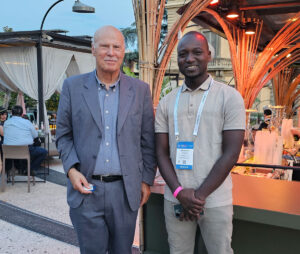
Prof. Wolfgang Grisold (left), WFN past-president, and Dr. Sangare Cheickna.
On Sept. 2, 2025, I officially began my role in the Clinical Neurophysiology Department at the Hôpital des Spécialités. From my first day, I was impressed by the department’s administrative rigor and organizational structure. The welcome I received from the department head, professors, and the entire technical team was particularly warm. Joining a department that was already so well organized, with clear protocols and a perfectly managed patient flow, was a key factor. This enabled me to find my feet immediately and to slot straight into the clinical routine and functional assessments without any transition period.
Clinical Activities and Training Program
The technical facilities at the Hôpital des Spécialités enabled me to gain training in the full range of functional investigations of the nervous system. My duties were divided between carrying out the examinations, interpreting the tracings, and providing clinical follow-up. The key examinations during my training included:
- EEG and ENMG: As these were the most frequently requested examinations within the department, I was assigned to them two to three times a week, ensuring I gained extensive exposure to both common and complex neurological conditions.
- Video-EEG: As part of the department’s routine, this technique enabled me to conduct a more in-depth syndromic analysis and to correlate the filmed clinical manifestations with electrical abnormalities.
- Polysomnography: Carried out once a week, this familiarized me with sleep medicine and the analysis of states of wakefulness.
- Evoked Potentials (EP): Carried out every two weeks, these tests complemented my training in the assessment of sensory pathways (visual, auditory, or somatosensory) and motor pathways (for motor evoked potentials).
This technical immersion was firmly underpinned by direct clinical work. Every Tuesday, the department organized specialist consultations led by Dr. Birouk. Due to the large number of trainee doctors, a fair rotation system was put in place, and I took an active part in these consultations when it was my turn. This valuable opportunity for discussion was essential for correlating the results of paraclinical tests with the patient’s clinical presentation and refining the diagnostic approach under the guidance of experts.
The Rhythm of Clinical and Educational Staff Meetings
The department’s daily activities were structured around highly specialized, multidisciplinary consultation meetings, ensuring a constant dialogue between clinical practice and technical expertise. These meetings included:
- Daily EEG staff meetings: At 8 a.m. every day (except Wednesdays), the team would meet for the EEG staff meeting. This daily session was dedicated to collective review, critical analysis of the previous day’s tracings, and the approval of reports.
- Video-EEG staff meeting: Every Wednesday at 8:30 a.m., a dedicated staff meeting was held to discuss video-EEG. During these sessions, we analyzed the electro-clinical correlations in the patients’ recordings, a fundamental exercise for refining the diagnosis of complex epileptic syndromes.
- ENMG and EP staff meeting: Every Thursday from 2 p.m., a staff meeting covering ENMG and EPs was held. This intensive session, devoted entirely to complex cases and neuromuscular disorders, was an inexhaustible source of learning. It was also during this staff meeting that we gained a deeper understanding of the interpretation of EPs. The focus was on analyzing the visual pathways — the most frequently requested in the department — to make a precise topographical diagnosis distinguishing between retinal, pre-chiasmatic, or retro-chiasmatic lesions. We also studied the clinical value and indications of other modalities, notably motor-evoked potentials (MEPs).
- Polysomnography team: Due to the frequency of this test, it was decided that a dedicated polysomnography team would meet once a month. These sessions were devoted to learning how to interpret sleep waveforms (stages of wakefulness, micro-awakenings) and to an in-depth study of the management of various sleep disorders.
Theoretical Teaching and Academic Activities
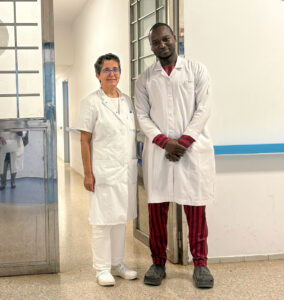
Dr. Nazha Birouk (left) head of the Clinical Neurophysiology Department at the Hôpital des Spécialités in Rabat, Morocco, and Dr. Sangare Cheickna.
Along with my clinical practice, my training was enriched by a rigorous and interactive theoretical program delivered by Dr. Birouk, focusing primarily on neuromuscular disorders and epileptology.
These teaching sessions followed a precise timetable drawn up according to the professor’s availability and were based on a particularly stimulating participatory teaching method. The day before each session, every clinician was instructed to carry out in-depth reading on the chosen topic. On the day itself, the session took the form of a dynamic discussion forum, structured around question-and-answer sessions and case discussions, enabling us to compare our reading with the professor’s clinical expertise.
Finally, the academic aspect of the fellowship was complemented by cross-departmental integration. Every other Friday, I took an active part in the neurology grand rounds, which were held in the neurology department’s lecture theatre. This fortnightly institutional meeting provided an opportunity for high-level multidisciplinary discussions, bringing together professors, senior consultants, and residents to discuss complex clinical cases and updates on the scientific literature.
Scientific Activities, Conferences, and Poster Presentations
Along with my clinical duties at Ibn Sina University Hospital, I have actively enriched my professional development through regular participation in leading national and international scientific events. This involvement has enabled me to keep my knowledge up to date and to present my own clinical research.
Scientific presentations (posters) presented:
- Congress of the Moroccan Society of Neurology (fall conference, Nov. 6-8, 2025): Poster presentation title: “Rasmussen’s Encephalitis: A Case Report.”
- 30th Congress of the Moroccan Society of Neurology (spring conference, April 30-May 2, 2026): Poster presentation title: “Grisel’s Syndrome: A Case Report and Review of the Literature.”
Specialized training courses and practical workshops:
- Practical ENMG Workshop (Moroccan EMG Club, Nov. 22, 2025): In-depth study of stimulation and detection techniques and refinement of manual skills for electroneuromyographic examination.
- Moroccan EMG Club Conference (June 20, 2026): A session to update protocols for the investigation of peripheral neuromuscular disorders.
- 10th Annual Continuum of the Moroccan Foundation for Neurology: Intensive continuing medical education sessions focused on neurological practice.
National and interdisciplinary conferences:
- 20th Congress of the Moroccan Association for Abnormal Movements: Updates on the clinical management and neurophysiological assessment of Parkinson’s and dyskinetic syndromes.
- 12th Congress of the Moroccan Society of Neuropediatrics: Focus on the specific features of pediatric EEG and pediatric epileptic syndromes.
- 15th Congress of the Moroccan Society of Neuropsychology (Feb. 6-7, 2026): Exploration of the interfaces between higher cognitive functions and neural networks.
International conferences and training courses (face-to-face and e-learning):
- 27th World Congress of Neurology 2026 (Oct. 12-15, 2025, Seoul, South Korea): Online participation in the flagship congress of the WFN, offering a global overview of diagnostic advances worldwide.
- Fifth WFN-AFAN e-Learning Day (Online, Dec. 13, 2025): Online participation in this day of high-caliber training organized jointly by the WFN and the African Academy of Neurology (AFAN), focusing on inflammatory diseases of the central nervous system.
- 19th International Congress on Neuromuscular Diseases (July 7-11, 2026, Florence, Italy): A high-level immersion at the heart of international research into motor neuron diseases, neuromuscular junction disorders, and myopathies, which we attended in person.
Research, Publications, and Academic Prospects
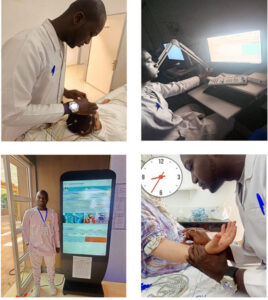
Dr. Sangare Cheickna participated in patient treatment, education, and scientific presentations during his year at the WFN Training Center at Hôpital des Spécialités in Rabat, Morocco.
In addition to my clinical work and participation in conferences, I have initiated and collaborated on several clinical research projects within the department, aimed at making the most of the Hôpital des Spécialités’ extensive database. These projects included:
Major thematic study: Chronic Demyelinating Inflammatory Polyradiculoneuritis (CDID). I carried out an in-depth research project, titled “Clinical and Electrophysiological Study of Chronic Demyelinating Inflammatory Polyradiculoneuritis (CDID) in the Clinical Neurophysiology Department in Rabat.” This project required the rigorous collection and exhaustive analysis of clinical data and electroneuromyography (ENMG) parameters drawn from the department’s historical database. This work enables a better characterization of the phenotypic profile and the kinetics of nerve conduction in these immune-mediated neuropathies within the local population.
Scientific publication (article submitted): I was the first author of a medical article titled “Sunflower Syndrome: A Case Report From the Clinical Neurophysiology Department.” This article, which highlights a rare form of photo-induced reflex epilepsy associated with stereotyped behaviors, has been officially submitted for publication to the Guinean Journal of Neurology, Neurosurgery, and Psychiatry (JNNP) and is currently undergoing peer review.
Master’s thesis project (sleep medicine): My research into arousal disorders has led to the identification of a case of narcolepsy. The critical analysis and interpretation of this patient’s specific electrophysiological pattern (characteristics of the polysomnography and repeated sleep latency tests) will form the central theme of my final dissertation for the master’s degree in sleep medicine.
Final Thoughts
In conclusion, this year’s clinical placement within the Clinical Neurophysiology Department at the Hôpital des Spécialités has been a decisive and highly formative stage in my medical and scientific career.
Access to a comprehensive range of technical facilities, combined with a rigorous academic program, has enabled me to develop a high degree of independence in the interpretation of EEGs, ENMG, EPs, and polysomnography. Beyond technical skills, the research carried out on a number of clinical syndromes has anchored my practice in a scientific approach of excellence.
I would like to express my deep and sincere gratitude to the WFN. By awarding me this scholarship of excellence, the WFN has provided me with an invaluable opportunity for international training. This institutional support demonstrates the federation’s vital commitment to the development of the neurosciences and the strengthening of medical expertise on a global scale.
My deepest thanks go to the entire team in the Clinical Neurophysiology Department at the Hôpital des Spécialités, and in particular to Dr. Birouk. I commend her great academic rigor, her generosity as a teacher, and the high quality of her theoretical and clinical teaching. Her interactive lectures, her sound advice during staff meetings, and her supportive supervision have been a constant source of inspiration.
Building on this high-level expertise, my aim is now to put all these clinical, technical, and scientific skills to good use within the health care system of my home country, with a view to optimizing the management of neurological and neuromuscular conditions there. •
Dr. Sangare Cheickna is a young neurologist from Bamako, Mali. He performed his neurology residency in Mali and performed his clinical neurophysiology fellowship as an awardee of an ICNMD/WFN grant to train at the WFN-accredited Training Center in Rabat, Morocco.