An advocacy journey in sub-Saharan Africa bridges the gap between growing needs and limited resources: a report from a 2025 Global Advocacy Leadership Program (GALP) participant.
By Daniel Gams Massi
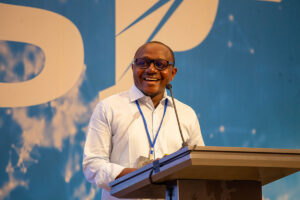
Dr. Daniel Gams Massi advocates for expanding modern stroke care and extending EEG services into underserved regions in sub-Saharan Africa.
Neurology in sub-Saharan Africa faces a paradox: a rising burden of stroke, epilepsy, and central nervous system infections against a critical shortage of trained specialists, subspecialty tools, and structured teaching. My advocacy has focused on turning that gap into concrete clinical capacity by bringing modern stroke care to my hospital, extending EEG access to underserved regions, leading genetics research that includes Africa in global data, and training the next generation of physicians.
The clearest marker of progress has been establishing successful intravenous thrombolysis for acute ischemic stroke at Douala General Hospital in Douala, Cameroon. This therapy, largely available in high income countries, was historically inaccessible in much of the region due to cost, diagnostic delays, and lack of trained teams. Making it work reliably meant building not just clinical skill but a whole pathway with rapid access to imaging, informed teams, and protocols adapted to our constraints.
This has been made possible by the support of the Académie de Recherche et d’Enseignement Supérieur (ARES) of Belgium through the University of Mons and the support of the World Federation of Neurology (WFN) to establish a pilot project for a National Stroke Registry in Cameroon.
A second success has been extending diagnostic reach beyond Douala through a tele-EEG project with the Regional Hospital Center of Bertoua, in the Eastern region of Cameroon, allowing patients far from any EEG-capable center to be evaluated without traveling hundreds of miles. This is advocacy in its most practical form: proving that specialist-level diagnostics don’t have to stop at the boundary of a teaching hospital.
On the research front, I serve as a principal investigator on GP2-TraPCAf, a multicenter Parkinson’s genetics study funded by Aligning Science Across Parkinson’s (ASAP) and the Michael J. Fox Foundation, with sites including Douala, Yaoundé, Bafoussam, and Bertoua. Leading enrollment, consent, and protocol implementation in Cameroon ensures African genomic data, long absent from Parkinson’s research, is represented in the datasets shaping future global understanding and treatment of the disease.
I also continue my journey with the African Academy of Neurology (AFAN) where I serve on the board of directors as a treasurer. And I have established some collaboration with international partners such as co-founding the Belgo-African Brain Reach Foundation with Dr. Lionel Paternoster (Université de Mons, Belgium). The foundation aims to support development of stroke units and other neurological initiatives across the continent. In addition, I co-direct the EPIPED African Project, which held its first International Pediatric EEG training course in 2025 in Douala and now funds a 12-month subspecialty fellowship in Bologna with Dr. Angelo Russo from Italy.
The challenges are common to most African settings: limited funding, fragile equipment logistics for programs like tele-EEG, and the constant tension between clinical service and protected time for training or research. I have used each success as a stepping stone to advance other projects.
My take-home message for young advocates: Do not wait for perfect infrastructure to start. Build the first working example in your hospital, university, or community; remain constant in effort and resilient in a resource-constrained setting; and let the evidence do the advocacy for you.
Daniel Gams Massi is a neurologist from Cameroon. He serves as treasurer of the African Academy of Neurology and was a 2025 Global Advocacy Leadership Program (GALP) fellow. (GALP is a joint advocacy leadership program of the American Academy of Neurology and the WFN).